Amasra Castle
Built in the Roman period, with walls added by the Byzantines; it stands on a narrow peninsula.
View on map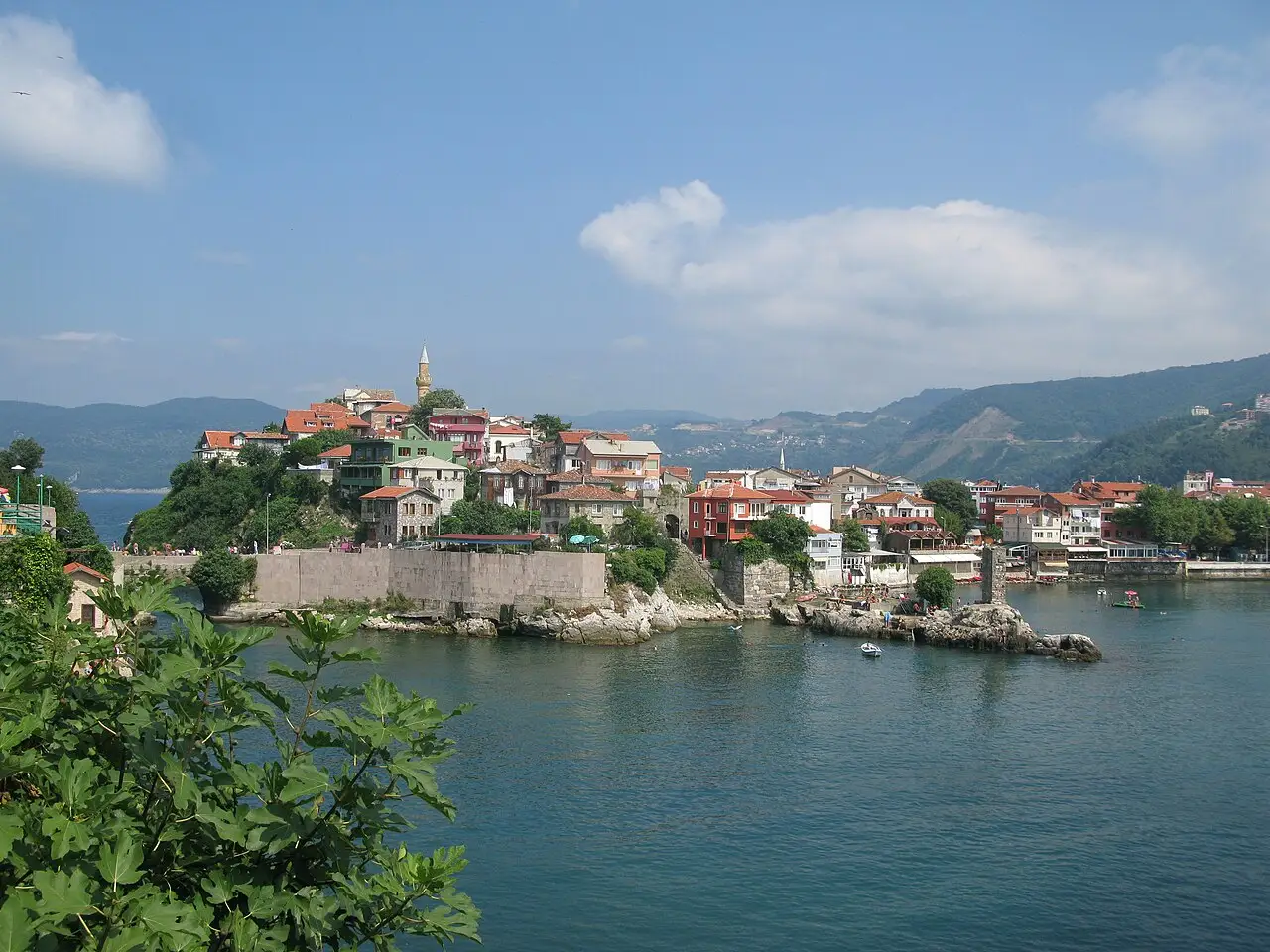 Photo: Babbsack (CC BY-SA 3.0) · Source
 8 places to visit in the Amasra district of Bartın: Amasra Castle, Kuşkayası Road Monument and Amastris Ancient City. Plan your trip to Amasra with local food, practical tips and transport information.
Stretching out into the sea, a headland and two coves make Amasra a distinctive tourist destination with its sheltered harbours.
Amastris, from whom the town takes its name, was a Persian princess and niece of Darius III, the last ruler of the Persian Empire. In the 13th century Amasra was taken by the Genoese, and in October 1460 an Ottoman army led by Fatih Sultan Mehmet launched a campaign against it. In 1987 it gained district status as part of Zonguldak province’s Bartın district, and in 1991, when Bartın province was established, it became a district of Bartın province.
Amasra Museum opened in 1955 in the municipal building and was moved to a larger building in 1982. The statue of the snake god Glykon, a deliberate fraud created by a local entrepreneur in the Roman imperial period, is of particular interest.
Amasra, under Genoese rule, was attacked by Fatih Sultan Mehmet’s army in October 1460. The first museum in Amasra opened in 1955 in a small hall in the municipal building. In 1991, when Bartın province was established, Amasra became a district of Bartın. Amasra is a member of the Association of Historical Towns and Regions of Europe for its architectural heritage. The Amasra Museum building was begun in 1884 as a maritime school and opened as a museum in 1982.
Amasra is an ancient city founded under the name Sesamos in 12 BC. Most of the population makes its living from the Coal Mining Enterprise, tourism, farming and fishing.
Last updated:
Built in the Roman period, with walls added by the Byzantines; it stands on a narrow peninsula.
View on mapAn ancient road monument built between AD 41 and 54 on the orders of Gaius Julius Aquila, governor of Bithynia and Pontus.
View on mapThe ancient city founded in the 4th century BC by Queen Amastris, grand-daughter of the Persian King Darius III. Excavations in 2025 brought to light the remains of a 2,000-year-old Roman-period stoa (colonnaded gallery). The forum, council hall, theatre and acropolis remains are preserved underground.
View on mapThe stone bridge built in the Byzantine period in the 9th century, linking Boztepe to the mainland, is one of the symbols of Amasra. It was restored in the Ottoman period by Fatih Sultan Mehmed.
View on mapThe Boztepe peninsula, which separates the two harbours of Amasra, is an ideal walking route with its pine forests and sea views. The open-sea panorama of the Black Sea can be seen from the summit.
View on mapThe museum displays archaeological and ethnographic finds from the Roman, Byzantine and Ottoman periods, and includes sculptures, coins and ceramics excavated from the ancient city of Amastris.
View on mapWhile you are in Amasra, you can also see the highlights of Bartın province. These places are in other districts.
Amasra salad, prepared with walnuts, pomegranate molasses, rocket and various greens, is a local meze served alongside fish dishes. Each restaurant has its own recipe.
Whiting caught in the cold waters of the Black Sea, prepared grilled or fried. It is the most popular dish in Amasra's fish restaurants.
Bartın pide, with its thin dough and generous fillings, is also widely eaten in Amasra in its minced meat and kaşar varieties.
Founded in the 4th century BC, Amastris was one of the most important ancient harbour cities of the Black Sea. The city, a strategic trade centre in the Roman, Byzantine and Genoese periods, has a multi-layered history that forms the basis of Amasra's cultural identity.
Fishing in Amasra is a tradition maintained for generations. With its two natural harbours, Amasra is one of the most important fishing towns on the Black Sea, and fishing culture is an inseparable part of daily life.
The Amasra economy rests on tourism, fishing and mining. With its historic fabric and natural beauty, Amasra is one of the most popular tourist destinations on the Black Sea, attracting hundreds of thousands of visitors a year. Fishing continues to be important as a traditional activity. Hard coal mines run by TTK play a significant part in the district's economy.
Amasra is 17 km from Bartın city centre. Access is by road. It is 300 km from Ankara and 400 km from Istanbul. The nearest airport is Zonguldak Airport (90 km). There are regular bus services from Bartın and Ankara.
The top 8 sights in Amasra are: Amasra Castle, Kuşkayası Road Monument, Amastris Ancient City, Boztepe, Amasra Museum, Kemere Bridge (Fatih Bridge), Bartın Bedesten and Amasra Lighthouse.
Amasra Salad, Izgara Mezgit and Bartın Pidesi are the standout dishes on Amasra's tables.
Amasra is known for its seafood and its Ancient Amastris Heritage. Thanks to Amasra's two natural harbours, fresh fish and seafood are the district's most important local products. Whiting, anchovy and horse mackerel are the main species caught.
Amasra is 17 km from Bartın city centre. Access is by road. It is 300 km from Ankara and 400 km from Istanbul. The nearest airport is Zonguldak Airport (90 km). There are regular bus services from Bartın and Ankara.
Suggested visit length: 2–3 days. Best time to visit: May–October.