Kyme (Cyme) Ancient City
One of the Aeolian cities located within the boundaries of Aliağa district, an ancient settlement.
View on map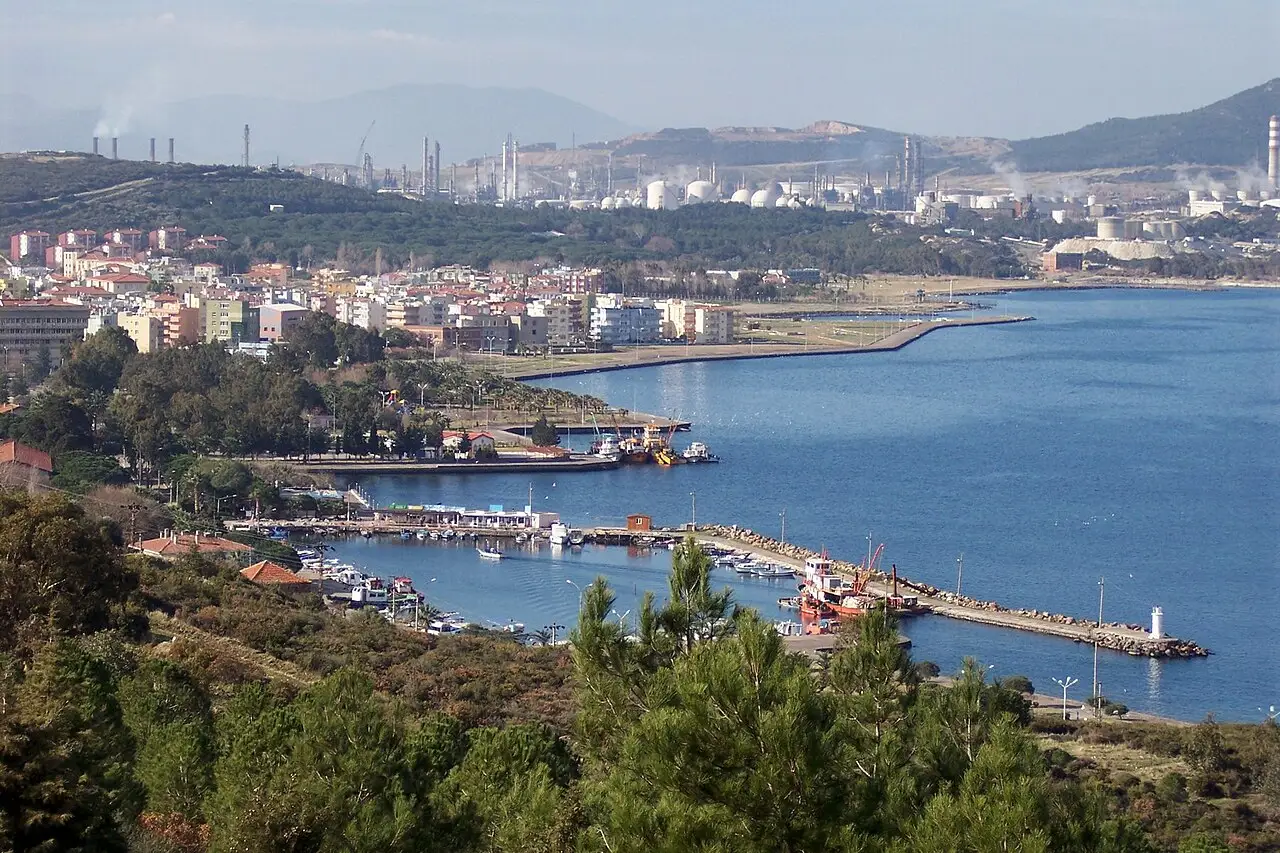 Photo: aokaratekin (CC BY-SA 3.0) · Source
 8 places to visit in the Aliağa district of Izmir: Kyme (Cyme) Ancient City, Güzelhisar Dam and Aliağa Tuzla Bird Paradise. Plan your trip to Aliağa with local food, practical tips and transport information.
Aliağa is bordered by Bergama to the north, Foça and Menemen to the south, Manisa province to the east and the Aegean Sea to the west.
In 1763 Ali Ağa had a mosque built in Güzelhisar and acquired extensive lands. From the 1840s onwards the Levantine Baltazzi family began to own lands in the area.
Aliağa bears traces of the İzmir and Bergama civilisations. Of the more than 30 Aeolian cities on the Aegean coast, 4 of the 12 cities are located within the district’s boundaries. Aliağa became a subdistrict (bucak) of Menemen in 1937, a municipality was established in 1952, and in 1982 it separated from Menemen to become a district. In the past, agriculture was the main economic activity in Aliağa; through state and private-sector investment it has become an industrial and port city.
The average elevation of Aliağa district centre above sea level is 20 metres. The district’s coast consists of many coves and headlands, and it has a total coastline of 63 km: 37 km of low coast and 26 km of high coast.
Aliağa has a Mediterranean climate, with hot, dry summers and mild, rainy winters, and an annual average temperature of 16.5 °C. The Güzelhisar Stream rises on Mount Yunt and, after leaving the Güzelhisar Dam, enters the boundaries of Aliağa.
The name Aliağa derives from Esseyyid Ali Ağa, a notable of the region. Aliağa separated from Menemen on 21 January 1982 to become a district. In Aliağa and its surroundings are the ancient cities of Kyme, Myrina, Gryneion, Tisna, Aigai, Elaia and Larissa. Helvacı Kilimi is a historic kilim woven in Helvacı Neighbourhood of Aliağa, registered as a geographical indication.
Last updated:
One of the Aeolian cities located within the boundaries of Aliağa district, an ancient settlement.
View on mapA 5.5 km walking route of easy difficulty leading to the ancient city of Samurlu-Kyme; on foot it takes 2 to 3 hours.
View on mapA walking route starting from Aliağa runs through Yeni Şakran and Kapukaya to the ancient city of Aigai; the route extends as far as Köseler village.
View on mapAn important wetland on the coastal part of the Güzelhisar Delta.
View on mapA 40-metre-high waterfall at the point where the boundaries of Aliağa, Manisa and Menemen meet. It is known as the largest waterfall in İzmir.
View on mapA wetland in the Güzelhisar Delta. In this 27-hectare area, 103 of Türkiye's 425 bird species have been observed at different seasons.
View on mapA harbour at the end of the walking routes, where groups stop for tea and where fish caught in the nets of local fishermen are served.
View on mapWhile you are in Aliağa, you can also see the highlights of Izmir province. These places are in other districts.
A traditional fish soup made with fresh fish from the Aegean, served with lemon and garlic.
Artichokes grown around Aliağa are cooked with olive oil, lemon and dill and served cold.
A wild herb dish of Cretan origin which, in Aliağa, merged with the cuisine of Balkan and island migrants and became one of the signature dishes of the region.
A red mullet dish prepared in the oven, specific to Şakran, which stands out for its olive oil culture.
Olive oil obtained from the Aliağa and Şakran region, described as high quality in terms of its chemical and sensory properties.
Traditional pomegranate molasses produced by natural methods in the homes of the Çıtak Neighbourhood at the foot of Dumanlı Mountain, where pomegranate trees grow.
A pastry handed down from generation to generation, made in the Çakmaklı Neighbourhood, where the population of Bosnian Herzegovinian origin is concentrated. In the area it is also known as Boşnak böreği (Bosnian pastry).
Keşkek made in the villages of Aliağa, especially Güzelhisar, at weddings, festivals and when soldiers are sent off.
Aliağa has been home to Kyme and Myrina, important centres of the ancient Aeolian civilisation. These ancient cities are among the earliest settlements on the Aegean coast.
Aliağa has one of the largest industrial zones in Türkiye. The TÜPRAŞ refinery, the PETKİM petrochemical plants and the ship-breaking yards form the economic base of the district. Alongside industry, olive growing and fishing are also practised.
Aliağa is 50 km from İzmir. There is a direct connection to İzmir city centre by the İZBAN suburban train. It lies on the İzmir–Çanakkale motorway.
The 8 highlights of Aliağa are: Kyme (Cyme) Ancient City, Güzelhisar Dam, Aliağa Tuzla Bird Paradise, Uçansu Waterfall, Aliağa Bird Paradise, Kyme (Samurlu-Kyme) Ancient City, Aigai Ancient City and Aliağa Fishing Harbour.
Aliağa Fish Soup, Stuffed Artichokes in Olive Oil, Şevket-i Bostan and Şakran-style oven-baked red mullet are the standout dishes on tables in Aliağa.
Aliağa is known for its Aliağa Olive Oil and its Legacy of the Aeolian Civilisation. The natural extra virgin olive oil obtained from olives grown on the fertile plains of Aliağa is an important agricultural product of the region.
Aliağa is 50 km from İzmir. There is a direct connection to İzmir city centre by the İZBAN suburban train. It lies on the İzmir–Çanakkale motorway.
Suggested visit length: 1 day. Best time to visit: spring and autumn.