History
The name Tirebolu comes from Tripolis, Greek for “Three Cities”. Tirebolu is first recorded in the 1st century AD, in Gaius Plinius Secundus’s Naturalis Historia. It is said to have been founded by the Milesians in the 7th century BC. After the Empire of Trebizond was founded in 1204, Tirebolu remained within its borders. After Fatih Sultan Mehmed conquered Trabzon in 1461, Tirebolu passed to Ottoman rule. During the War of Independence, Giresunlu Topal Osman Ağa and Tirebolulu Hüseyin Avni Alparslan Bey played a major role in the struggle. The people of Tirebolu lost 248 martyrs in the War of Independence.
Geography
Tirebolu lies on the Black Sea coast, east of Giresun, and is 45 km from Giresun city centre. The district covers 259 km², and the average elevation of the district centre above sea level is 18 metres.
Culture and Economy
Culturally, the district shares similarities with other Çepni communities in the region and with Trabzon. Kemençe and horon are very much part of weddings and engagements. The most important source of livelihood is hazelnuts, and Tirebolu is known to grow some of the finest hazelnuts.
History and Culture
The name Tirebolu comes from Tri+Polis, Greek for “three cities”. In late 1920, Tirebolu was made a sub-prefecture and attached to Giresun. Tirebolu is a typical Eastern Black Sea settlement, which, because of its mountainous terrain and limited farmland, has sent people away to migrate. Tirebolu Castle underwent extensive restoration and repair in earlier years. According to its inscription, Selimağa Fountain was built on 10 June 1842 by Kethüdazade Emin Ağa.
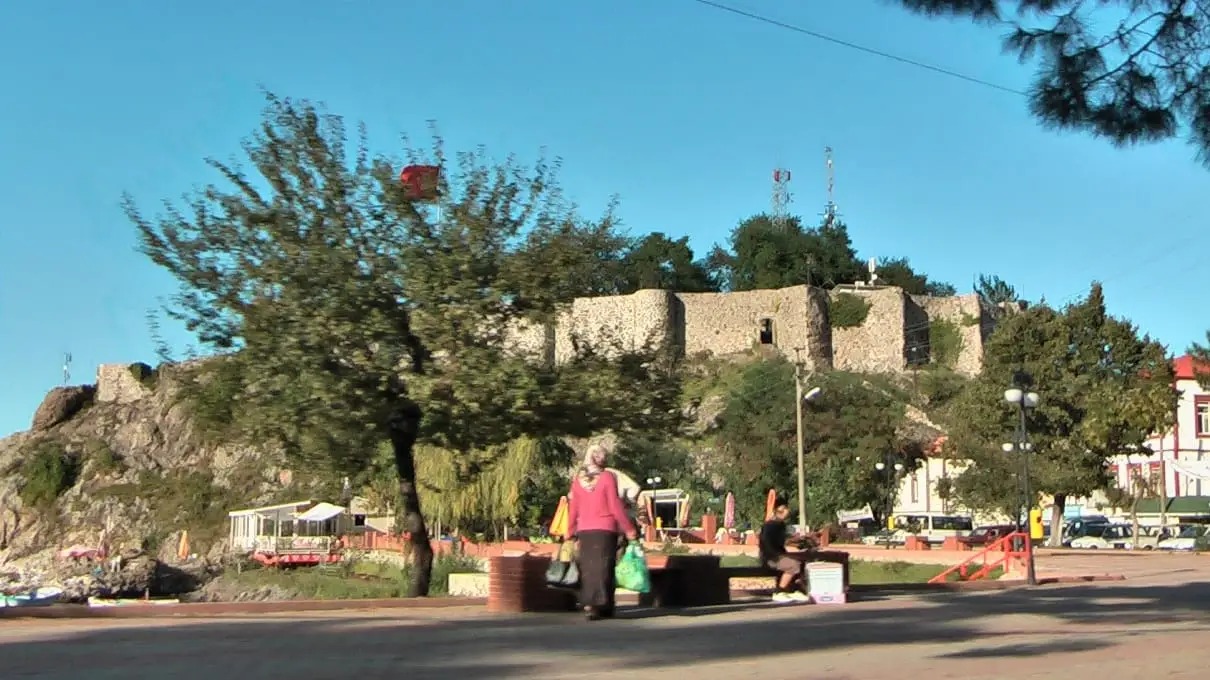
 Photo: Elelicht (CC BY-SA 3.0) · Source