Antalya is Türkiye's richest route of ancient cities and coastline, from Kaleiçi with Hadrian's Gate and the Yivli Minaret to the Roman theatre of Aspendos, and from the UNESCO World Heritage site of Xanthos–Letoon to the sunken city of Kekova. With the Konyaaltı and Lara beaches, the Düden waterfalls and the 520-km Lycian Way, it can be visited in every season.

Share with friends

Last updated:

Places to Visit in Antalya

23 places worth seeing in Antalya, from historic monuments to natural wonders, grouped by type. Open any of them on the map with a single click.

  • 3 Historic
  • 12 Ancient City
  • 1 Religious
  • 1 Museum
  • 5 Nature
  • 1 Beach

Historic Sites 3

Historic

Kaleiçi

The historic city centre, enclosed by sea and land walls, is the heart of Antalya, with streets that carry Roman, Byzantine, Seljuk and Ottoman layers and restored old Antalya houses. The old harbour, the Yivli Minaret and Hadrian's Gate are all here.

View on map
Historic

Alanya Castle

The walls of the castle on the peninsula, which rises about 250 metres from the sea, are 6.5 km long in total. The castle, which goes back to the Hellenistic period, was rebuilt by the Seljuk Sultan Alâeddin Keykubad I, who took the city in 1221.

View on map
Historic

Kızıl Kule (Red Tower)

The octagonal tower in Alanya harbour was built in 1226 by Alâeddin Keykubad I for the master Ebu Ali Reha el-Kettani of Aleppo, who also built Sinop Castle; it is the symbol of the city.

View on map

Ancient Cities 12

Ancient City

Hadrian's Gate (Üçkapılar)

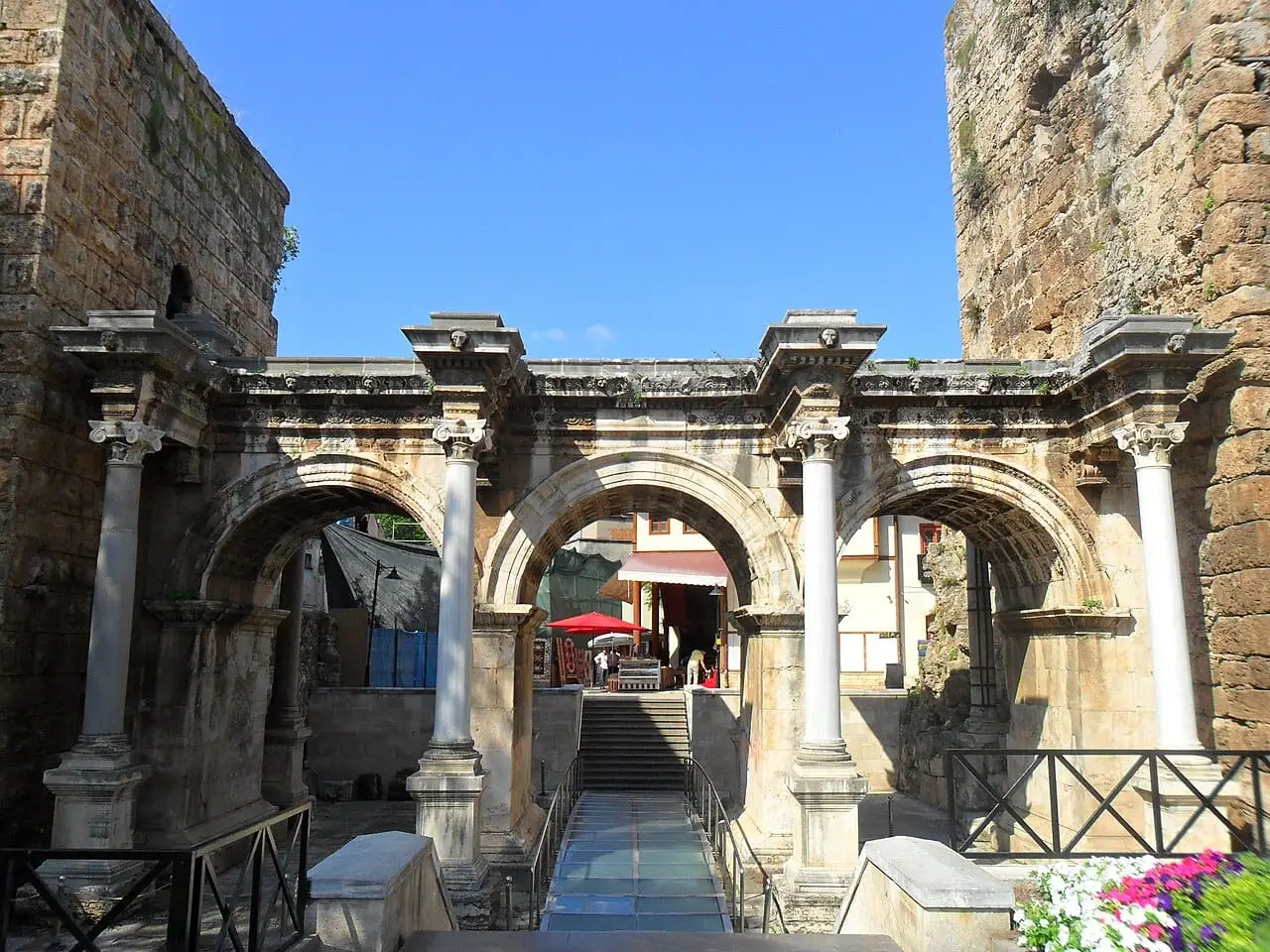
A monumental gate with three arches and four marble columns on each face, built into the city walls in honour of the Roman emperor Hadrian's visit to the city in AD 130. Its upper storey has not survived; it was uncovered in 1882 and restored in 1959.

View on map
Ancient City

Perge Ancient City

Perge, in Aksu 18 km east of Antalya, was once the capital of Pamphylia and counted among the richest cities of the ancient world in the Hellenistic period. It was the home town of the mathematician Apollonius of Perga and appears as Parha in Hittite sources.

View on map
Ancient City

Aspendos

A Pamphylian city founded 8 km east of Serik, where the Köprüçay reaches the plain; its theatre, built by the Romans in the 2nd century AD, is among the best-preserved theatres of the ancient world and still hosts performances today.

View on map
Ancient City

Side Ancient City

Side, in the district of Manavgat, takes its name from an Anatolian word meaning 'pomegranate'. A port city dating back to the Hittite period, it is one of the most photogenic ancient sites on the Mediterranean, with the columns of the temples of Apollo and Athena facing the sea.

View on map
Ancient City

Termessos

Founded at an altitude of about 1,150 metres on the slope of Mount Güllük, 30 km north-west of Antalya, this is one of the best-preserved ancient cities in Türkiye; set among pine forests, it lies inside the national park that bears its name.

View on map
Ancient City

Karain Cave

Karain, in the Yağca neighbourhood 27 km from Antalya, is one of the largest natural caves in Türkiye and an important prehistoric settlement that has been used since the Palaeolithic.

View on map
Ancient City

Phaselis

An ancient port city set among pine forests in Olympos Beydağları National Park, 17 km west of Kemer; you can swim in its bays, which are interwoven with the ancient ruins.

View on map
Ancient City

Olympos and Yanartaş

Olympos, a Lycian city in Kumluca 10 km north of Mount Tahtalı, lies on the Lycian Way, and its beach is a nesting ground for Caretta caretta turtles. At nearby Çıralı, the flames of natural gas escaping from the rocks, which have burned for thousands of years, are known as Yanartaş (Chimaera).

View on map
Ancient City

Myra and the Church of Santa Claus

Myra, the Lycian city in Demre, is impressive for its theatre and its rock-cut tombs in the cliff face. The church in town where Saint Nicholas, known as Santa Claus, served as bishop, and where he is believed to have lain for a time after his death, is today the Saint Nicholas Memorial Museum.

View on map
Ancient City

Kekova and Kaleköy (Simena)

On the northern shore of the uninhabited 4.5-km² island of Kekova, near Demre, you can see the ruins of the ancient city of Dolichiste, which sank beneath the water in the earthquakes of the 2nd century. Kaleköy (Simena) on the opposite shore can be reached only by boat; a castle and Lycian sarcophagi stand above the village.

View on map
Ancient City

Xanthos and Letoon

Xanthos, in the village of Kınık in Kaş, was the capital of Lycia; nearby Letoon was the religious centre dedicated to Leto and her children. The two sites were inscribed together on the UNESCO World Heritage List on 9 December 1988.

View on map
Ancient City

Patara

Patara, near the town of Kalkan in Kaş, was the capital of the Lycian League; the assembly building where the League's representatives met is among the earliest known examples of representative democracy. A long, natural beach stretches in front of the ancient city.

View on map

Religious Buildings 1

Religious

Yivli Minaret

A 13th-century Seljuk work and the symbol of Antalya, with an eight-fluted shaft of brick and turquoise tiles rising from a cut-stone base. It is 38 metres high.

View on map

Museums 1

Museum

Antalya Museum

Founded in 1922 to protect antiquities from the occupying forces, the museum holds about a hundred thousand objects from Lycia, Pamphylia and Pisidia and is one of the largest archaeology museums in Türkiye; most of the marble statues come from Perge. In 1988 it received the Council of Europe's Special Prize for Museum of the Year.

View on map

Natural Wonders 5

Nature

Düden Waterfalls

The Düden Stream splits into two branches to form two waterfalls: Upper Düden near Varsak, and Lower Düden (Karpuzkaldıran) near Lara, which plunges straight from the cliffs into the sea. Lower Düden is about 8 km from the city centre.

View on map
Nature

Kurşunlu Waterfall

A waterfall that drops 18 metres inside a 2-km canyon, 7 km off the Antalya–Isparta road at its 24th km, with seven small pools; it has been open to visitors as a nature park since 1986.

View on map
Nature

Damlataş Cave

A cave on the western shore of Alanya Castle, found in 1948 when dynamite was set off while stone was being quarried for harbour construction; it is decorated with thousands of stalactites and stalagmites.

View on map
Nature

Köprülü Canyon National Park

A canyon 14 km long and 100 metres deep, carved by the Köprü Stream between Bolasan and Beşkonak in Manavgat; it is known for its cedar forests, rafting routes and an ancient stone bridge that is still in use.

View on map
Nature

Lycian Way

A waymarked walking route of about 520 km from Fethiye to Antalya; it takes an average of 29 days to walk and is the first long-distance trail in Türkiye, passing through ancient Lycian cities.

View on map

Beaches and Coves 1

Beach

Konyaaltı and Lara Beaches

The city's two main beaches: pebbly Konyaaltı in the west, with views of the Beydağları, and Lara in the east, with its broad sandy shore. Close to the city centre, they are ideal for a day by the sea.

View on map

Getting to Know Antalya

Antalya lies on the Mediterranean coast, where the Taurus Mountains descend to the sea, at the meeting point of the three regions of antiquity: Pamphylia, Lycia and Pisidia. Within the province are dozens of ancient cities belonging to these civilisations: Perge, the capital of Pamphylia; Aspendos, famous for its Roman theatre; the port city of Side; Xanthos, the capital of Lycia; Patara, where the assembly of the Lycian League met; Myra, where Saint Nicholas served as bishop; and Termessos, the Pisidian city on the slope of Mount Güllük.

The city itself is the successor of Attaleia, founded by Attalus II, King of Pergamon. Hadrian’s Gate, built in honour of the Roman emperor Hadrian’s visit in AD 130, is still the entrance to Kaleiçi today. In the 13th century the Seljuks left the city the Yivli Minaret, and in Alanya the castle, the Kızıl Kule and the shipyard that Sultan Alâeddin Keykubad I had rebuilt.

Today Antalya is the capital of Turkish tourism: after Istanbul, the second busiest airport in Türkiye is here. With its beaches, Xanthos–Letoon, inscribed on the UNESCO World Heritage List in 1988, and the Lycian Way running from Fethiye to Antalya, the province offers not just a seaside holiday but also a long journey through culture and nature.

When to Go

Antalya has a typical Mediterranean climate: summers are very hot and dry, and winters are mild and rainy. Averages for 1930–2025 from the Turkish State Meteorological Service:

Month Avg. high Avg. low Rainfall Rainy days
January 15.0 °C 6.1 °C 226 mm 12
February 15.6 °C 6.4 °C 148 mm 10
March 18.0 °C 8.1 °C 91 mm 9
April 21.4 °C 11.3 °C 49 mm 6
May 25.7 °C 15.3 °C 33 mm 5
June 30.8 °C 19.7 °C 11 mm 3
July 34.2 °C 22.9 °C 5 mm 1
August 34.1 °C 22.9 °C 4 mm 1
September 31.2 °C 19.6 °C 17 mm 2
October 26.6 °C 15.4 °C 71 mm 5
November 21.4 °C 10.9 °C 128 mm 7
December 16.7 °C 7.7 °C 251 mm 12

Late May to October is ideal for a seaside holiday, and April–May and October–November are ideal for the ancient cities and the Lycian Way. In July and August the average high reaches 34 °C; visit shadeless archaeological sites such as Termessos, Perge and Aspendos early in the morning in these months. Winter is mild, but December and January are the rainiest months of the year.

How to Get to Antalya

By air: Antalya Airport is the second busiest airport in Türkiye by passenger numbers after Istanbul Airport, and lies east of the city centre. For Alanya and the eastern coast, Gazipaşa–Alanya Airport in Gazipaşa is closer (45 km from Alanya).

By bus: Antalya bus station is connected to the stations Otogar and Batıgar on the city’s light rail system, Antray; the city centre is easily reached by tram.

By road: The city lies at the junction of the coastal road to Kemer–Kaş–Fethiye in the west, the Side–Alanya coastal road in the east and the Burdur–Isparta road in the north. Hiring a car is the most practical way to reach most of the ancient cities.

Antalya Area by Area

  • City centre (Muratpaşa, Konyaaltı, Kepez): Kaleiçi, Hadrian’s Gate, the Yivli Minaret, the Antalya Museum, the Düden waterfalls, and the Konyaaltı and Lara beaches.
  • East (Aksu, Serik, Manavgat, Alanya): Perge, Aspendos, Side, Köprülü Canyon, Alanya Castle, the Kızıl Kule, and the Damlataş and Dim caves.
  • West and the Lycian coast (Kemer, Kumluca, Finike, Demre, Kaş): Phaselis, Olympos and Yanartaş, Myra and the Church of Santa Claus, Kekova, Kaş, Patara, Xanthos and Letoon.
  • Interior (Döşemealtı, Korkuteli, Elmalı): Termessos, Karain Cave and the Taurus highland pastures.

Suggested Itineraries

Day 1 – Kaleiçi and the city: Enter Kaleiçi through Hadrian’s Gate, walk the narrow streets to the Yivli Minaret and go down to the old harbour. In the afternoon see the Perge statues in the Antalya Museum, and in the early evening watch the sunset from the cliffs where Lower Düden Waterfall pours into the sea.

Day 2 – Pamphylia: Go early in the morning to Perge (18 km east of the centre), then to the theatre at Aspendos; in the afternoon see the columns of the Temple of Apollo at Side’s ancient harbour.

Day 3 – The Lycian coast: Go via Kemer to Phaselis, then to Olympos and, in the evening, Yanartaş; or, on a longer route, see Myra and the Church of Santa Claus in Demre and join a boat tour at Kekova.

Alternative: For nature, rafting in Köprülü Canyon; for culture, Termessos and Karain Cave.

Antalya Cuisine

Antalya’s most famous dish is Antalya piyazı, with a geographical indication, in which dried beans meet a tahini sauce; it is usually eaten with şiş köfte. Registered products include Finike portakalı (Finike oranges, of the Washington Navel type), Antalya kabak tatlısı (pumpkin dessert), Korkuteli karyağdı armudu (Korkuteli karyağdı pears), Alanya yenidünyası (Alanya loquats), tavşan yüreği zeytini (tavşan yüreği olives) and Döşemealtı el halısı (Döşemealtı handmade carpets). In winter the city markets are full of fresh oranges and other citrus fruits, and in summer tropical fruits are plentiful in the coastal districts.

Practical Tips

  • Most archaeological sites have no shade; in summer a hat, water and sun cream are essential.
  • The beaches of Olympos and Çıralı are nesting grounds for sea turtles (Caretta caretta); keep to the marked areas.
  • For walking the Lycian Way, choose spring and autumn; the long stages are demanding in the summer heat.
  • The stone streets of Kaleiçi are steep and slippery; wear comfortable shoes.
Districts of Antalya

Antalya province has 19 districts. Explore the places to visit, local dishes and transport in each one.

What to Eat in Antalya

All dishes →
  • Antalya Piyazı (bean salad with tahini sauce)

    A piyaz with a geographical indication, in which dried beans meet a tahini and vinegar sauce; it is usually served with şiş köfte.

  • Antalya Kabak Tatlısı (pumpkin dessert)

    A pumpkin dessert with a registered geographical indication.

  • Finike Portakalı (Finike oranges)

    Washington Navel oranges with a geographical indication, grown in the alluvial soils of the Akçay and Alakır streams.

  • Korkuteli Karyağdı Armudu (Korkuteli karyağdı pears)

    A pear with a geographical indication, specific to Korkuteli.

  • Alanya Yenidünyası (Alanya loquats)

    Alanya yenidünyası (loquat), harvested in spring, with a geographical indication.

What to eat in Antalya: the full food guide

Antalya: Frequently Asked Questions

What are the best places to visit in Antalya?

In the city centre, Kaleiçi, Hadrian's Gate, the Yivli Minaret and the Antalya Museum; the ancient cities of Perge, Aspendos, Side, Termessos, Phaselis, Olympos, Myra, Kekova, Xanthos–Letoon and Patara; and the Düden and Kurşunlu waterfalls, Köprülü Canyon and Alanya Castle are the main stops.

Does Antalya have any UNESCO World Heritage sites?

Yes. The ancient cities of Xanthos and Letoon in Kaş were inscribed together on the UNESCO World Heritage List in 1988.

Which airport do you fly to for Antalya?

Antalya Airport serves the city centre, and Gazipaşa–Alanya Airport serves Alanya and the eastern coast. Antalya Airport is the second busiest airport in Türkiye.

When can you swim in the sea in Antalya?

The sea season lasts from late May to late October. In July and August the weather is very hot (average high 34 °C).

What is Antalya famous for?

Antalya piyazı with tahini and şiş köfte, Finike oranges and kabak tatlısı; it is also famous for its ancient cities, its beaches and the Lycian Way.

Where is the Church of Santa Claus?

The church of Saint Nicholas, known as Santa Claus, is in the Demre district of Antalya and can be visited as the Saint Nicholas Memorial Museum.

More from the Antalya Guide

Other Provinces in the Mediterranean Region

Sources

The information in this guide has been compiled from and checked against the sources below (last checked: 7 October 2026). If you spot an error, please let us know.

  1. Vikipedi – Antalya
  2. Meteoroloji Genel Müdürlüğü – Antalya il istatistikleri
  3. Vikipedi – Kaleiçi, Muratpaşa
  4. Vikipedi – Hadrian Kapısı
  5. Vikipedi – Yivli Minare
  6. Vikipedi – Antalya Müzesi
  7. Vikipedi – Düden Şelalesi
  8. Vikipedi – Kurşunlu Şelalesi
  9. Vikipedi – Perge
  10. Vikipedi – Aspendos
  11. Vikipedi – Side
  12. Vikipedi – Termessos
  13. Vikipedi – Karain Mağarası
  14. Vikipedi – Faselis
  15. Vikipedi – Olimpos, Kumluca
  16. Vikipedi – Çıralı, Kemer
  17. Vikipedi – Mira (antik kent)
  18. Vikipedi – Noel Baba Kilisesi
  19. Vikipedi – Kekova
  20. Vikipedi – Ksanthos
  21. Vikipedi – Litoon
  22. Vikipedi – Patara
  23. Vikipedi – Alanya Kalesi
  24. Vikipedi – Kızılkule
  25. Vikipedi – Damlataş Mağarası
  26. Vikipedi – Köprülü Kanyon Millî Parkı
  27. Vikipedi – Likya Yolu
  28. Vikipedi – Antalya Havalimanı
  29. Vikipedi – Gazipaşa-Alanya Havalimanı
  30. Vikipedi – Konyaaltı Plajı
  31. İstiklal – Antalya'nın kabak tatlısına coğrafi işaret
  32. Ekonomi Gazetesi – Antalya coğrafi işaretli ürünler
  33. Küre Ansiklopedi – Finike Portakalı

Search 81 province guides and 968 district guides.