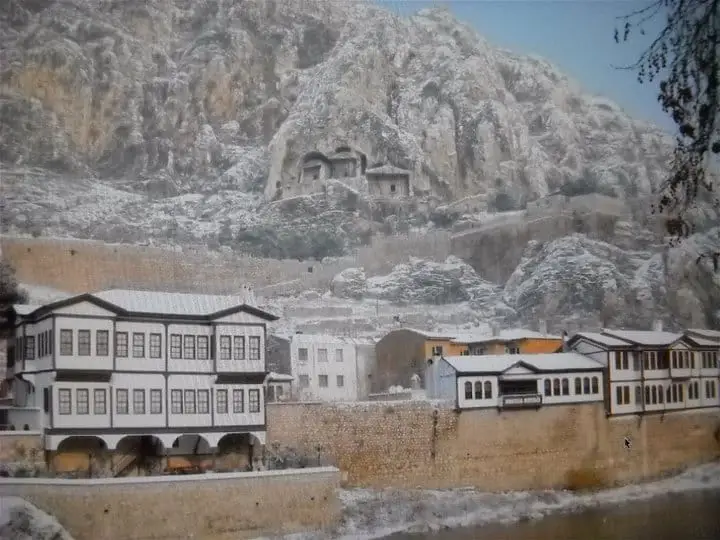
With its Yalıboyu houses lined along both banks of the Yeşilırmak and the rock tombs of the Pontic kings on the hill above, Amasya is one of the most photogenic cities in Türkiye. It was the capital of the Kingdom of Pontus, the 'city of princes' where Ottoman princes were trained, and the city where the first circular of the War of Independence was issued; it is also famous for its misket apples and çörek.

Share with friends

Last updated:

Places to Visit in Amasya

13 places worth seeing in Amasya, from historic monuments to natural wonders, grouped by type. Open any of them on the map with a single click.

  • 3 Historic
  • 2 Ancient City
  • 4 Religious
  • 3 Museum
  • 1 Nature

Historic Sites 3

Historic

Amasya Castle (Harşena)

The castle stands on the steep Mount Harşena above the Yeşilırmak; it changed hands many times in the Persian, Pontic, Roman and Byzantine periods, and the Seljuks repaired it extensively in 1075. The section known as 'Cilanbolu' contains a passage carved into the rock, and the summit offers a bird's-eye view of the city.

View on map
Historic

Yalıboyu Houses

Traditional Amasya houses lined along the bank of the Yeşilırmak, built in the 19th and 20th centuries using the hımış and bağdadi techniques. These courtyard houses, with separate haremlik and selamlık sections, make up the city's postcard view.

View on map
Historic

Hazeranlar Mansion

Built in 1865 and restored in 1979, the mansion can be visited as an ethnography museum, furnished with clothing, carpets, kitchen utensils and jewellery that reflect life in 19th-century Amasya.

View on map

Ancient Cities 2

Ancient City

Royal Rock Tombs

Monumental Hellenistic-period tombs carved into the limestone rocks on the southern foot of Mount Harşena. In the Kızlar Sarayı area are the tombs of five Pontic kings, from Mithridates I to Pharnaces I; together with those inside the castle, there are 21 rock tombs in the valley in total. Behind the tombs are passages carved into the rock.

View on map
Ancient City

Aynalı Cave

A worked rock tomb 3.3 km outside the city on the road to the town of Ziyaret; it is 9.8 metres wide and 13 metres high. Its façade was burnished until polished, so it gleams when the sun strikes it, and it takes its name (aynalı, 'mirrored') from this.

View on map

Religious Buildings 4

Religious

Sultan Bayezid II Complex

Built by Bayezid II in 1486, this is the largest complex in the city, made up of an inverted-T-plan mosque with two domes, a madrasa, an imaret (soup kitchen), a şadırvan (ablution fountain) and a library. With its five-domed portico and two minarets, it stands on the bank of the Yeşilırmak.

View on map
Religious

Burmalı Minare Mosque

Named after its twisted minaret and also known as the Grand Mosque and the Court Mosque, the building is attributed to the vizier Ferruh Bey in the reign of Kayhusraw II (1237–1247). It stands out for the Seljuk tomb (kümbet) next to it and for its position behind the Coppersmiths' Bazaar.

View on map
Religious

Gökmedrese Mosque and Torumtay Tomb

A complex built in 1267 by the governor of Amasya, Seyfeddin Torumtay; it takes its name from the blue-glazed bricks of the tomb's drum. With its iwan-shaped portal, it is among the finest mosques in Anatolia.

View on map
Religious

Bayezid Paşa Mosque

A mosque with a zawiya, built in 1414 by the governor of Amasya, Bayezid Paşa, in the reign of Mehmed I, north-east of Kunç Bridge; it stands out for the marble geometric decoration of its portico.

View on map

Museums 3

Museum

Darüşşifa (Sabuncuoğlu Museum of the History of Medicine and Surgery)

According to its inscription, the darüşşifa (hospital) was built in 1308 under the Ilkhanid ruler Öljeitü and his wife İlduz Hatun, and is known as the first hospital in Anatolia to treat patients with music. Since 2011 it has been a museum describing the surgical instruments and methods of Sabuncuoğlu Şerefeddin, chief physician in the time of Mehmed the Conqueror.

View on map
Museum

Amasya Archaeology and Mummy Museum

Established in 1958 as a museum directorate and in its present building since 1980, the museum holds about 24,000 objects belonging to 11 different civilisations. The 14th-century mummies displayed in the Tomb of Mesud I in the garden are among the rarest exhibits in Türkiye.

View on map
Museum

Ferhat and Şirin Minstrels Museum

The museum at the entrance to the city tells the Amasya legend in which Ferhat is believed to have pierced the mountains to reach Şirin.

View on map

Natural Wonders 1

Nature

Lake Boraboy (Borabay)

A natural dammed lake about 25 km from Taşova, formed when a landslide caused by the North Anatolian Fault blocked the valley; with its wooded surroundings it is ideal for picnics and walks.

View on map

Getting to Know Amasya

Amasya lies in the interior of the Black Sea region, where the Yeşilırmak passes through a narrow valley at the foot of the steep Mount Harşena. The fabric of the city spreads along both sides of this valley: on one side the Yalıboyu houses lined up along the river, and above them the royal tombs carved into the rocks and the castle.

Strabo, the most famous geographer of antiquity, was born in Amasya and refers to the city as Amaseia in his Geographica. The city was one of the capitals of the Kingdom of Pontus; in the Royal Rock Tombs on the southern foot of Mount Harşena are the tombs of five Pontic kings, from Mithridates I to Pharnaces I (160 BC). The Seljuks repaired the castle in 1075 and made the city an important centre again; the Darüşşifa, built under the Ilkhanids in 1308, is known as the first hospital in Anatolia to treat patients with music.

In Ottoman times Amasya was the “city of princes”: many sultans, above all Murad II, Mehmed the Conqueror and Selim I, served as princes here and learned how to govern. The complex that Bayezid II had built in 1486 is the city’s largest Ottoman group of buildings. Sabuncuoğlu Şerefeddin, chief physician in the time of Mehmed the Conqueror, also lived in this city and wrote the first Turkish surgical book, Cerrâhiyyetü’l-Hâniyye, here.

Amasya also has a special place in the founding of the Republic of Türkiye: Mustafa Kemal arrived in the city on 12 June 1919 and, with the Amasya Circular issued on 22 June 1919, effectively began the War of Independence, declaring “The independence of the nation will be saved by the nation’s own resolve and decision.”

When to Go

Amasya has a climate in transition between the Black Sea and Central Anatolia; the Yeşilırmak valley gives the city a relatively mild climate. Averages for 1961–2025 from the Turkish State Meteorological Service:

Month Avg. high Avg. low Rainfall Rainy days
January 7.1 °C −0.7 °C 50 mm 12
February 9.9 °C 0.4 °C 37 mm 11
March 14.7 °C 3.1 °C 49 mm 13
April 20.5 °C 7.3 °C 54 mm 13
May 25.1 °C 11.1 °C 55 mm 13
June 28.8 °C 14.6 °C 40 mm 9
July 31.2 °C 16.8 °C 17 mm 3
August 31.6 °C 16.8 °C 10 mm 3
September 28.0 °C 13.1 °C 20 mm 5
October 22.0 °C 8.7 °C 35 mm 8
November 14.7 °C 4.0 °C 43 mm 9
December 9.0 °C 1.4 °C 54 mm 13

The loveliest periods are April–June and September–October. In spring the valley turns green; autumn is the harvest season for misket apples. In July and August the average high is around 31 °C, but inside the valley it can at times be much hotter (record: 45 °C).

How to Get to Amasya

By air: Amasya Merzifon Airport, open to domestic flights, is in the district of Merzifon and about 42 km from Amasya city centre.

By train: Amasya Station, opened in 1927 and renovated in 2020, is on the Samsun–Kalın railway; the Samsun–Amasya, Amasya–Havza and Samsun–Sivas regional trains call at the city. Coming from Samsun by train is a pleasant way to follow the Yeşilırmak valley.

By road: Amasya lies on the Samsun–Ankara and Samsun–Sivas–Tokat roads, on the route that links the Black Sea to Central Anatolia.

Suggested Itineraries

Day 1 – Both banks of the Yeşilırmak: In the morning climb to the Royal Rock Tombs (reached by a stepped path) and enjoy the panorama of the city. Walk past the Yalıboyu houses to Hazeranlar Mansion. In the afternoon visit the Bayezid II Complex, Burmalı Minare Mosque, Gökmedrese Mosque and the Sabuncuoğlu Museum of the History of Medicine and Surgery in the Darüşşifa. In the evening watch the illuminated rock tombs and houses from the opposite bank of the river.

Day 2 – The castle and the museum: In the morning climb to Amasya Castle on Mount Harşena; the passage carved into the rock and the bird’s-eye view of the city are here. Then visit the Amasya Archaeology and Mummy Museum, with its 14th-century mummies; the Ferhat and Şirin Minstrels Museum at the entrance to the city and the Aynalı Cave, 3.3 km outside the city, can also be added to the route.

Day 3 – Nature: Walk and picnic at Lake Boraboy (Borabay), about 25 km from Taşova.

Amasya Cuisine

Amasya cuisine is rich in dishes that received geographical indications one after another in 2021–2022: Amasya çöreği and burmalı Amasya çöreği (twisted Amasya çörek), baklalı dolma (broad-bean stuffed vegetables), etli çiçek bamyası (okra with meat), toyga çorbası (yoghurt and wheat soup), patlıcan pehli (aubergine dish), Amasya yağlısı (layered pastry) and Amasya keşkeği (Amasya keşkek) are among the registered dishes. The city’s symbol is the Amasya misket elması (Amasya misket apple), registered with a protected designation of origin in 2019: thin-skinned, firm and long-lasting, this apple is red on one side and yellow-green on the other, and shows a star shape inside when cut in half.

Practical Tips

  • The climb to the Royal Rock Tombs and the castle is steep and stepped; wear comfortable shoes.
  • The Yalıboyu houses and the rock tombs are illuminated in the evening; do not miss an evening walk along the river bank.
  • The best time to buy misket apples is autumn.
  • Most of the buildings in the city centre are within walking distance; walking is the most enjoyable way to see Amasya.
Districts of Amasya

Amasya province has 7 districts. Explore the places to visit, local dishes and transport in each one.

What to Eat in Amasya

All dishes →
  • Amasya Çöreği (Amasya bread rolls)

    A traditional çörek that received a geographical indication on 24 August 2021; its twisted (burmalı) variety was registered separately in 2022.

  • Amasya Etli Çiçek Bamyası (okra with meat)

    A meat dish made with small, fresh çiçek okra; it received a geographical indication on 22 November 2021.

  • Baklalı Dolma (broad-bean stuffed vegetables)

    A stuffed dish specific to Amasya, registered on 17 August 2021.

  • Toyga Çorbası (yoghurt and wheat soup)

    A traditional soup made with yoghurt and wheat, registered on 1 December 2021.

  • Patlıcan Pehli (aubergine dish)

    An aubergine dish that received a geographical indication on 5 April 2022.

  • Amasya Keşkeği (Amasya keşkek)

    Keşkek (wheat and meat porridge), registered on 28 July 2022.

What to eat in Amasya: the full food guide

Amasya: Frequently Asked Questions

What are the best places to visit in Amasya?

The Royal Rock Tombs, Amasya Castle, the Yalıboyu Houses, Hazeranlar Mansion, the Bayezid II Complex, Burmalı Minare Mosque, Gökmedrese Mosque, the Darüşşifa (Museum of the History of Medicine), the Archaeology and Mummy Museum and Lake Boraboy are the main stops.

Who do the Royal Rock Tombs belong to?

The tombs on Mount Harşena were made for the kings of the Kingdom of Pontus; they include the tombs of five kings, from Mithridates I to Pharnaces I. There are 21 rock tombs in the valley in total.

Which airport do you fly to for Amasya?

Amasya Merzifon Airport is about 42 km from the city centre.

Why is Amasya known as the city of princes?

In Ottoman times many princes, above all Murad II, Sultan Mehmed the Conqueror and Sultan Selim I, served as governors in Amasya and learned how to rule.

What is Amasya famous for?

It is famous for its misket apples, çörek, okra and keşkek, as well as the Pontic royal rock tombs and the Yalıboyu houses.

When was the Amasya Circular issued?

The Amasya Circular was issued on 22 June 1919; Mustafa Kemal arrived in the city on 12 June 1919.

More from the Amasya Guide

Other Provinces in the Black Sea Region

Sources

The information in this guide has been compiled from and checked against the sources below (last checked: 7 October 2026). If you spot an error, please let us know.

  1. Vikipedi – Amasya
  2. Vikipedi – Amasya (il)
  3. Meteoroloji Genel Müdürlüğü – Amasya il istatistikleri
  4. Vikipedi – Kral Kaya Mezarları
  5. Vikipedi – Amasya Kalesi
  6. Vikipedi – Amasya Yalıboyu Evleri
  7. Wikipedia – Bayezid II Mosque, Amasya
  8. Lonely Planet – Hazeranlar Konağı
  9. Vikipedi – Amasya Sabuncuoğlu Tıp ve Cerrahi Tarihi Müzesi
  10. Vikipedi – Burmalı Minare Camii
  11. Vikipedi – Torumtay Türbesi
  12. Vikipedi – Bayezid Paşa Camii (Amasya)
  13. Vikipedi – Amasya Arkeoloji ve Mumya Müzesi
  14. Vikipedi – Aynalı Mağara
  15. Vikipedi – Boraboy Gölü
  16. Vikipedi – Amasya Genelgesi
  17. Vikipedi – Amasya Merzifon Havalimanı
  18. Vikipedi – Amasya Garı
  19. Vikipedi – Amasya elması
  20. Amasya İl Tarım ve Orman Müdürlüğü – Misket elması coğrafi işaret tescili
  21. Türk Patent – Amasya Misket Elması tescil belgesi

Search 81 province guides and 976 district guides.