Getting to Know Ankara
Ankara is a city set in the heart of Central Anatolia that has been the capital of Türkiye since 13 October 1923. Although it is known today for its modern ministry buildings, wide boulevards and universities, its history goes back thousands of years.
The area around the city was one of the centres of Phrygian civilisation: Gordion, the capital of Phrygia, was continuously settled near Polatlı from 2300 BC to the 4th century AD and was added to the UNESCO World Heritage List in 2023. Of Ancyra, an important city of the Galatians and then of Rome, the Temple of Augustus, the Roman Bath from the time of Caracalla and the Column of Julian survive today. On the walls of the Temple of Augustus is the inscription, known as the Monumentum Ancyranum, that recounts the deeds of the emperor Augustus.
The grandest work of the Seljuk and Ahi period is the Arslanhane (Ahi Şerafeddin) Mosque at the southern end of the castle; in 2023 it joined the UNESCO list under “Medieval Anatolian Mosques with Wooden Columns and Beams”. The mosque and tomb bearing the name of the 15th-century Sufi Hacı Bayram-ı Veli were built right next to the Temple of Augustus.
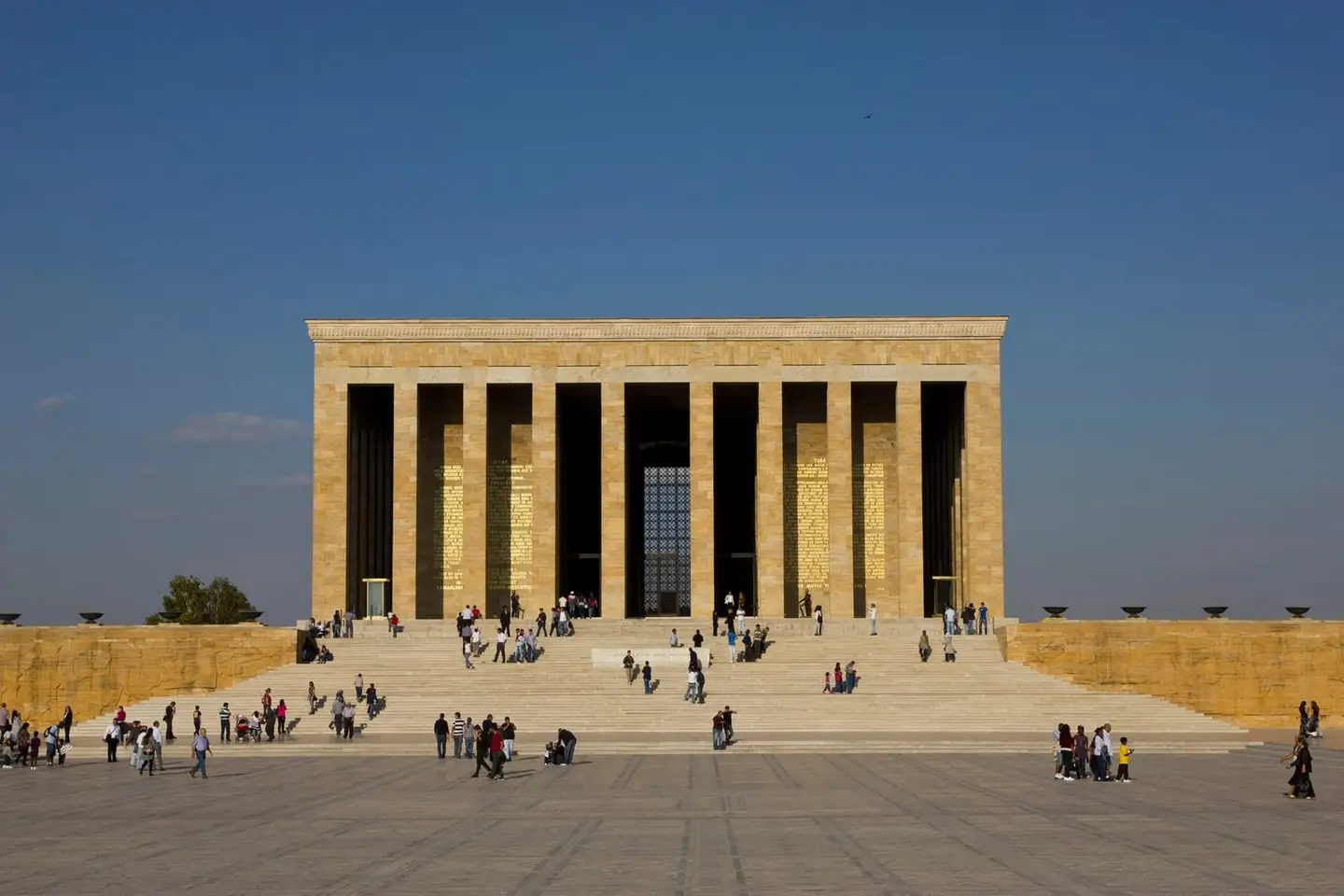
During the War of Independence Ankara was the centre of the national struggle: in 1920 the Grand National Assembly of Türkiye met in the building that is now the War of Independence Museum. After Atatürk’s death in 1938 his body remained in the Ethnography Museum for 15 years and was moved to Anıtkabir on 10 November 1953.
When to Go
Ankara has a continental climate: summers are hot and dry, winters are cold and snowy. Averages for 1927–2025 from the Turkish State Meteorological Service:
| Month |
Avg. high |
Avg. low |
Rainfall |
Rainy days |
| January |
4.4 °C |
−3.1 °C |
40 mm |
12 |
| February |
6.5 °C |
−2.2 °C |
35 mm |
11 |
| March |
11.6 °C |
0.8 °C |
39 mm |
11 |
| April |
17.4 °C |
5.5 °C |
42 mm |
11 |
| May |
22.4 °C |
9.7 °C |
52 mm |
12 |
| June |
26.7 °C |
13.0 °C |
37 mm |
9 |
| July |
30.4 °C |
15.9 °C |
15 mm |
4 |
| August |
30.6 °C |
16.1 °C |
13 mm |
3 |
| September |
26.1 °C |
11.9 °C |
18 mm |
4 |
| October |
20.0 °C |
7.2 °C |
27 mm |
7 |
| November |
13.1 °C |
2.6 °C |
31 mm |
8 |
| December |
6.6 °C |
−0.6 °C |
44 mm |
12 |
The best times for a city visit are April to June and September to October. Summer days are hot but dry, and evenings cool down. Commemorations are held at Anıtkabir on 10 November and visitor numbers rise sharply; on national holidays such as 29 October and 23 April, Anıtkabir and the Ulus area are also crowded.
How to Get to Ankara
By air: Esenboğa Airport, which opened in 1955, is about 25 km north-east of the city centre.
By high-speed train: Ankara High-Speed Train Station, which opened in 2016, is the starting point of the Ankara–Istanbul and Ankara–Sivas high-speed railways; YHT services to Eskişehir and Konya also leave from here. It is right next to the historic Ankara Station.
By bus: Intercity buses arrive at AŞTİ (Ankara Intercity Bus Terminal Operations); from the terminal, the Ankaray line takes you to Kızılay.
Getting Around
The Ankara Metro, which opened in 1997, is Türkiye’s second metro system after Istanbul’s. In addition to the M1 (Kızılay–Batıkent), M2 (Kızılay–Koru), M3 (Batıkent–Törekent) and M4 (Kızılay–Şehitler) lines, the Ankaray light rail system runs between AŞTİ and Dikimevi. The historic centre of Ulus and the castle district can be explored on foot; Anıtkabir is reached by a short journey from Tandoğan (Ankaray) or Kızılay.
Suggested Itineraries
Day 1 – Ulus and the castle district: In the morning visit the Museum of Anatolian Civilisations (allow at least 2 hours), then go in through the castle gate and climb the walls of Ankara Castle. See the Arslanhane Mosque at the southern end of the castle and the Çengelhan Rahmi M. Koç Museum opposite it; in the afternoon move on to the Hacı Bayram Mosque, the Temple of Augustus and the Roman Bath. End the day among the restored Ottoman houses of Hamamönü.
Day 2 – Ankara of the Republic: Visit Anıtkabir early in the morning (at least 2–3 hours for the Lion Road, the Hall of Honour and the Atatürk and War of Independence Museum). In the afternoon see the War of Independence Museum (First Grand National Assembly) and the Republic Museum (Second Grand National Assembly) in Ulus, then the Ethnography Museum on Namazgâh Hill.
Day 3 – Outside the city: At Gordion, 94 km to the west, see the Midas Tumulus and the museum, or tour the mansions of Beypazarı, about 100 km to the north-west, and the İnözü Valley. For those who want nature, Soğuksu National Park, 80 km to the north, is a good alternative.
Ankara Cuisine
The best-known dish of old Ankara cooking is Ankara tavası: sautéed meat and vegetables are baked in the oven in meat stock with rice or vermicelli, and it is traditionally eaten on communal occasions such as weddings, hıdrellez and mesire picnics, with cacık, pickles and hoşaf. At breakfast, Ankara simidi, Beypazarı kurusu (which received a geographical indication in 2013) and Çubuk pickles stand out. Cevizli tatlı sucuk, made from strings of Beypazarı walnut kernels, is also a souvenir with a geographical indication.
Practical Tips
- Visitors to Anıtkabir are expected to observe dress and conduct rules; large bags go through a security check.
- The Museum of Anatolian Civilisations and the castle stand on the same hill; plan both for the same morning.
- It is easy to travel between Ulus and Kızılay by metro and bus; the streets of the castle district are steep and cobbled, so wear comfortable shoes.
- Snowfall and ice are frequent in winter; in January and February, plan trips outside the city according to the weather.